jamgrad



Inspired by Micrograd and many other light autograd implementations.
But why jamgrad? Because it's jam-packed with features! Actually, no, I am from Romania, we love making jam.
setup
python -m venv jamenv
source jamenv/bin/activate

pip install pytest pytest-cov numpy torch scikit-learn pandas
pip install .
test
To run tests with verbose output:
pytest tests -v
With coverage:
pytest tests --cov=jamgrad
documentation
Generate documentation using MkDocs Material:
pip install mkdocs mkdocs-material pymdown-extensions

make docs-serve
Build static docs into docs/:
make docs-build
quick start
from jamgrad import Tensor

# Basic operations
x = Tensor([2.0], requires_grad=True)
y = x ** 2
y.backward()
print(x.grad)  # [4.0]

# Neural networks
from jamgrad.nn import Linear
layer = Linear(2, 1)
output = layer(Tensor([[1.0, 2.0]]))
demo
basic tensor + autograd demo
python demos/demo.py
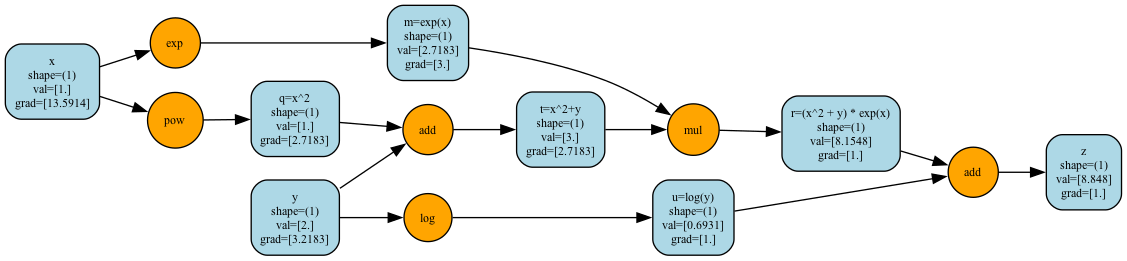
chain rule walkthrough
python demos/demo_chain_rule.py
\[
z = (x^2 + y) e^x + \ln(y)
\]
\[
\frac{\partial z}{\partial x}
= \frac{\partial}{\partial x} \big[ (x^2 + y)e^x + \ln(y) \big]
= (2x)e^x + (x^2 + y)e^x
= e^x (2x + x^2 + y)
\]
\[
\text{At } x = 1, \, y = 2:
\quad
\frac{\partial z}{\partial x} = e^1 (2 + 1 + 2) = 5e \approx 13.591409
\]
\[
\frac{\partial z}{\partial y}
= \frac{\partial}{\partial y} \big[ (x^2 + y)e^x + \ln(y) \big]
= e^x + \frac{1}{y}
\]
\[
\text{At } x = 1, \, y = 2:
\quad
\frac{\partial z}{\partial y} = e^1 + \frac{1}{2} = e + 0.5 \approx 3.2182818
\]
\[
z = (1^2 + 2)e^1 + \ln(2)
= 3e + \ln(2)
\approx 8.847993
\]
eigenvalue demo
Run dominant-eigenvalue estimation with power iteration (using Tensor matmul/ops):
python demos/demo_eigenvalues.py --matrix symmetric3 --iters 200
xor neural network demo
python demos/demo_nn.py --epochs 1000 --lr 0.5 --hidden-size 4
mnist neural network demo
python demos/demo_mnist.py --dataset-size 5000 --epochs 20 --batch-size 64 --lr 0.01
computation graph visualization