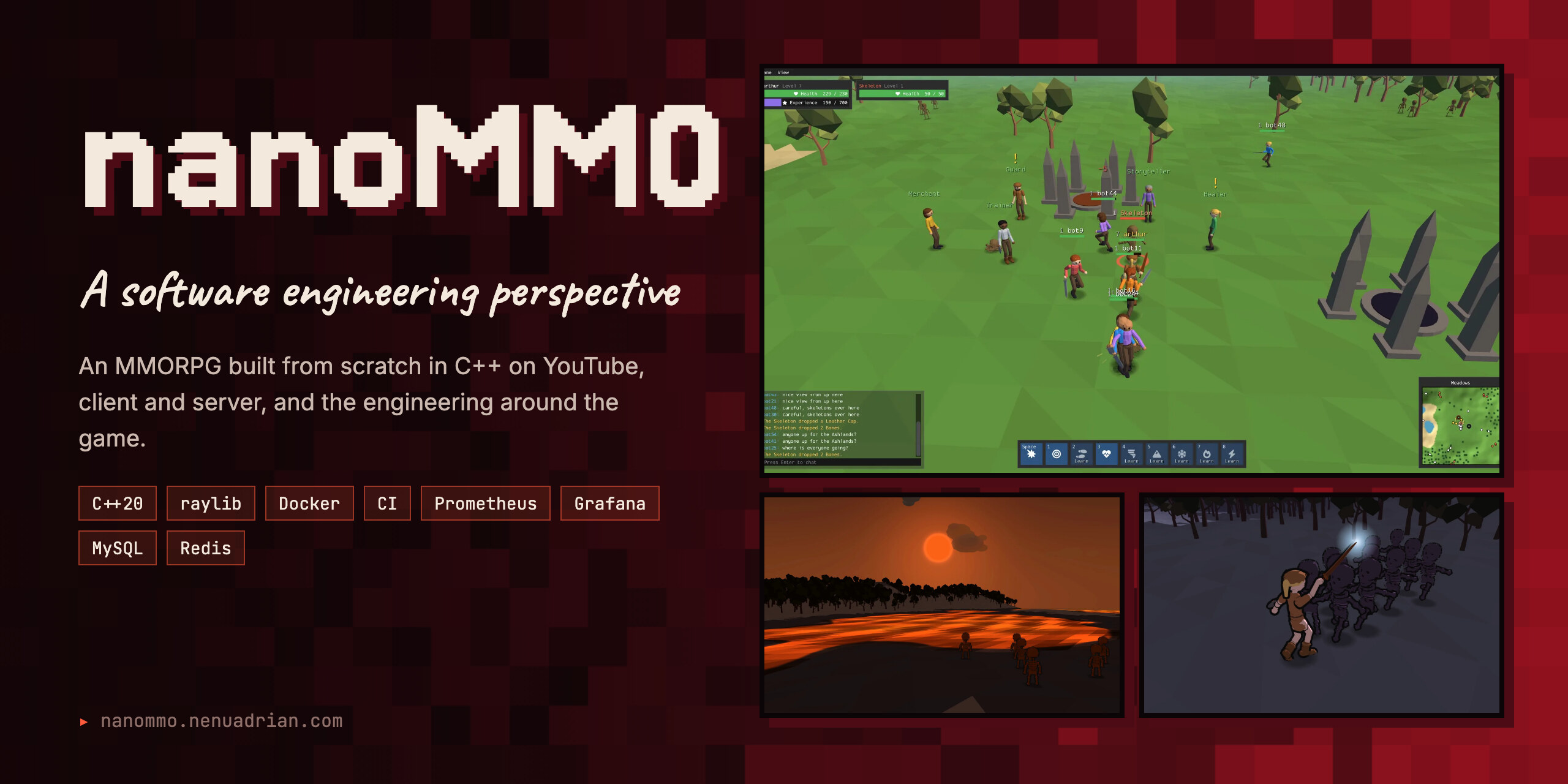
nanoMMO








nanoMMO is a devlog where I build an MMO from scratch in C++, with features I'd like to see exist, even if some might be impractical for most games, such as players creating their own skills. It's a learning journey, with the software engineering and the hard parts out in the open, and not always about the gameplay. It covers a C++ server, a C++ client, and everything around them.
The episodes are on YouTube, from the plan in episode one. Each episode's code is a git tag (ep001/end, ep002/end, ...), and the series' website has a page for each episode, with its code at each step. The reasons behind the design are in docs/decisions.
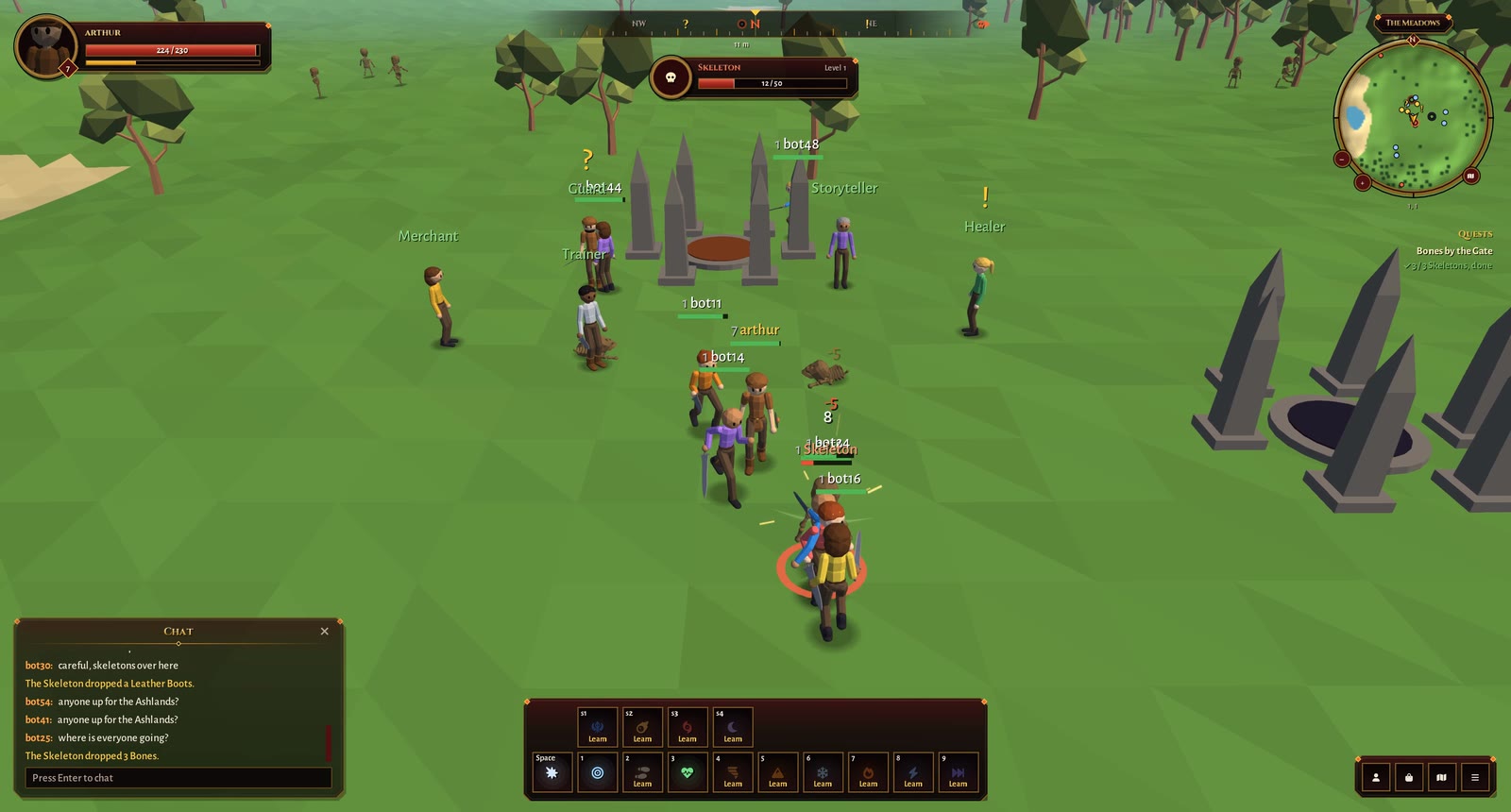
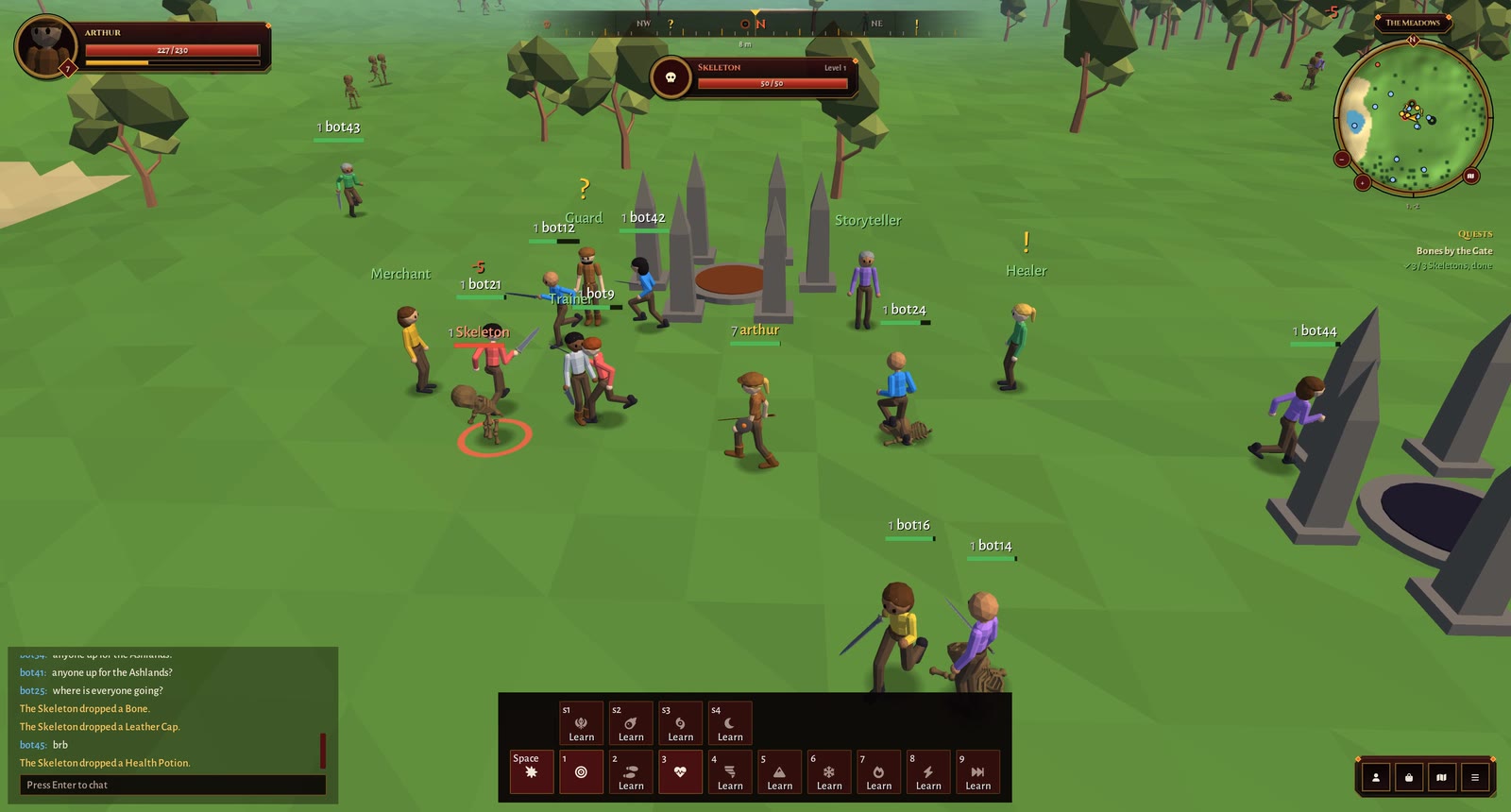
More screens, and every episode, are on the series' website.
Get started
Getting started goes from a clone to playing, a step at a time, on macOS and Ubuntu 24.04, with what each error means. The short version takes you as far as the login server.
Then start the world and the game, each in a terminal of its own.
Or build and check it all with only Docker installed.
In Docker, the client's tests open their window on a virtual display from Xvfb, and render with llvmpipe, Mesa's OpenGL driver that runs on the CPU. So they don't need a screen or a GPU.
The servers keep accounts in MySQL, and hand logins over through Redis. The game server saves the players into Redis, and a saver takes them on to MySQL (see Saving players). Each game server is a world, which registers with Consul, and the login server lists the worlds from there (see Worlds). Docker Compose runs MySQL, Redis, Consul and the saver, and before them Flyway, which makes the tables from the migrations in db/ (see Migrations). The clients talk to the servers over TLS, with certificates from an authority of our own, which scripts/certificates.sh makes the first time (see TLS). The client asks the login server on localhost, or on the host you give it, and how to play from another computer is in Getting started.
protocol/nanommo.proto is the contract between the client and the servers. The build runs protoc on it, and all sides use the C++ it generates. Items, monsters and NPCs are data (see Content).
Docs
How each part of the game works is in docs/, a page each, which the API docs have in their menu too.
- Getting started goes from a clone to playing, on macOS and Ubuntu, and says what each error means.
- Gameplay covers making a character, monsters, health and levels, fighting, skills, items and gold, quests, chat, guilds, trading, crafting, duels and guild wars, factions, the names over heads, and the help and the settings.
- Content has the items, monsters, NPCs, quests, skills, recipes and factions, as data the servers, the client and the bots read, checked as a graph in smollerGraph.
- NPCs says who stands where, and has the heralds and the storyteller, which tells stories with mvGPT.
- Graphics and sound covers the characters, the interface, the map, the sky, day and night, the weather, the music, the sound effects and the weather's, made from numbers, and the post-processing, with bloom, cel shading and anti-aliasing.
- Cinema covers filming the game frame by frame, in slow motion, with a stage of players and monsters, for the trailer.
- Worlds and lands covers the game servers, which Consul lists, and each world's lands and dungeons.
- The island covers each land's ground, trees and sea, made from a seed, and drawing them fast.
- Networking covers TCP and UDP when packets are lost, what each player gets, and what happens near them.
- Accounts, logins and TLS has the login server, the tokens, and TLS with an authority of our own.
- Saving players and migrations covers the players in Redis, the saver that takes them on to MySQL, and Flyway's migrations.
- The website covers the Laravel website, with its rankings and accounts.
- Monitoring, logs, traces and analytics covers Prometheus and Grafana, the bots, alerts, logs in Loki, traces in Tempo, and analytics in ClickHouse.
- Benchmarking and profiling has the load test, flame graphs, Pyroscope and Tracy, and chaos experiments.
- Reliability has the objectives and their error budgets, the alerts on how fast those burn, what breaking things on purpose found, and the postmortems.
- Deployment covers running a server with Docker Compose, handing players over without downtime, and deploying on push.
- The client in a browser covers the client built with Emscripten, drawing with WebGL 2 in a page, what differs there, and playing offline, and online through the gateway.
- Translations has the client in English and Romanian, gettext's PO files, plurals, the content's names, the servers' sentences as messages the client translates, pseudo-localisation, adding a language, and what stays English.
- Code style and checks covers clang-format and cpplint, the sanitizers, the fuzzers, clang-tidy and the coverage report.
- Versions and dependencies covers the game's version, which clients the login server lets in, releases, and keeping the libraries, images and packages up to date.
- Decisions says why the game is built the way it is, with a short record for each choice that would be costly to undo, and what it costs us.
